Fleet Exec
Fleet Exec is fleet-level remote command orchestration: pick a batch of devices, dispatch by command template, and collect results and audit centrally.
Flow
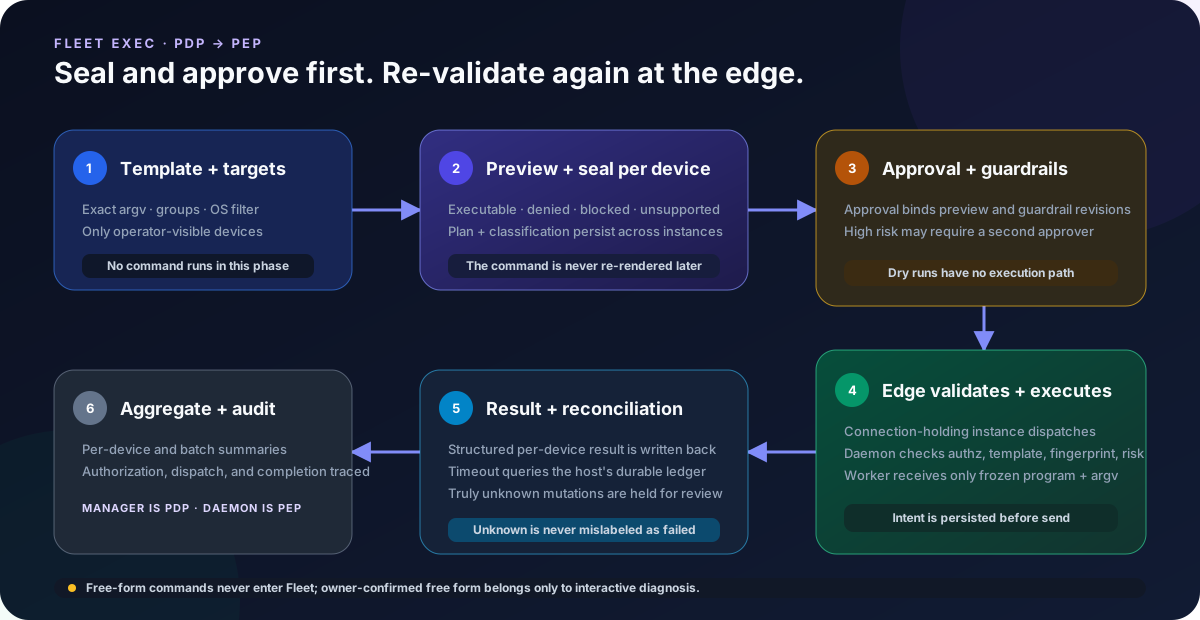
- Choose a command template (which constrains the executable command shape).
- Select target devices or device groups.
- Manager performs a zero-execution preview: every device is classified as executable, denied, blocked, or unsupported, and its plan plus classification are sealed in the database. A dry run stops here and has no execution path by construction.
- The operator approves the sealed preview; high-risk guardrails may require a second approver. Approval is bound to the preview generation and guardrail revision, so it cannot authorize a plan that has changed.
- The Manager instance holding the target signaling connection dispatches the plan. The host Daemon re-validates authorization, template, fingerprint, and risk ceiling; the Worker receives only the frozen program and
argv. - Manager aggregates structured results and audit. On timeout it queries the host's durable execution ledger; a genuinely unknown mutation is held for human review rather than mislabeled as an ordinary failure.
Decision vs Execution
Manager is the policy decision point (PDP), responsible for preview, approval, and sealing each device plan. The host Daemon is the policy enforcement point (PEP) and independently re-validates before handing work to the Worker. The edge therefore does not blindly trust a command merely because it came from the center—even across Manager instances.
Safety Constraints
- Executable commands are constrained by command templates and AI policies — nothing runs freely.
- The Fleet PEP always rejects free-form commands. The per-command owner exception on an owner's own device belongs only to interactive diagnosis and never expands Fleet authority.
- Dispatch intent is persisted before the network send and deduplicated by execution generation; reconnect/retry logic never treats a possibly executed mutation as definitely not run.
- Every execution enters AI Audit for traceability.
Related
- Template definition: Command Templates.
- Policy control: AI Policies.
- Traceability: AI Audit.